Connect with us

News

Ohanaeze urges FG to prioritise South East development commission

Published

on

Spread the love


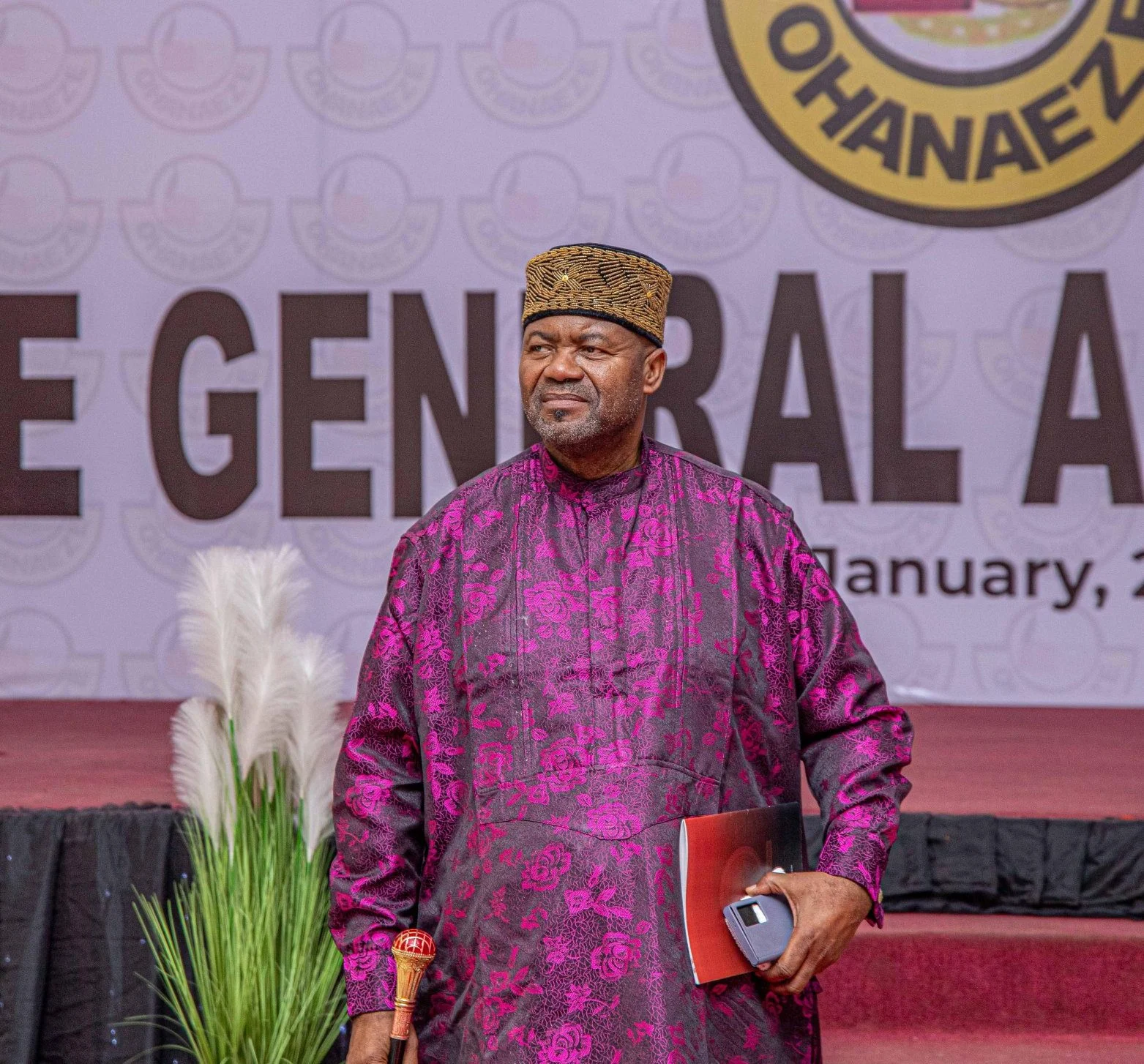
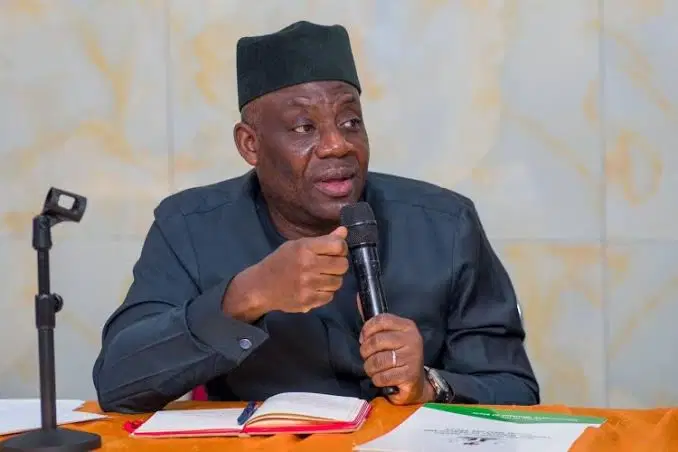
The President-General of Ohanaeze Ndigbo Worldwide, John Azuta-Mbata, has called on the Federal Government to prioritise adequate and sustained funding of the South-East Development Commission as a means of promoting national reconciliation and addressing long-standing grievances in the region.

Azuta-Mbata made the call on Wednesday at the ongoing four-day South-East Vision 2050 Regional Stakeholders Forum in Enugu, describing the commission as a tangible demonstration of the Federal Government’s commitment to equity and justice.

The forum, which began on Tuesday, is aimed at charting a unified socio-economic development roadmap for the South-East and repositioning the region as a global industrial hub by 2050.

It has attracted governors, private sector leaders, professionals in the diaspora and other stakeholders.

While acknowledging the South-East’s significant contributions to Nigeria’s growth through innovation and entrepreneurship, the Ohanaeze leader said feelings of exclusion and neglect had persisted in parts of the region.

“It would be dishonest not to acknowledge that over the years, feelings of exclusion, neglect and unresolved grievances have taken root in parts of our region. If left unaddressed, these sentiments can weaken national cohesion,” Azuta-Mbata said.

He stressed that the importance of the SEDC goes beyond infrastructure development, describing it as a critical instrument for reconciliation and healing.

“I respectfully appeal to the Federal Government to fully utilise the South-East Development Commission by providing it with appropriate and sustained funding.

“This will not only accelerate development, but also help assuage lingering ill feelings, rebuild confidence and heal old wounds in Igboland,” he added.

Earlier, the Managing Director of the SEDC, Dr Mark Okoye, said the South-East is currently burdened by an infrastructure deficit estimated at about $10bn, underscoring the need for regional collaboration.

Okoye urged the five South-East states—Abia, Anambra, Ebonyi, Enugu and Imo—to pursue large-scale, bankable projects collectively rather than compete for limited investment capital.

“The signal sent by the physical and virtual presence of Igbo professional groups from across America, Europe and Asia underscores a collective readiness to rebuild the regional economy,” he said.

He disclosed that the region receives an estimated $4bn annually in diaspora remittances, which, according to him, should be channelled into legacy projects such as regional gas pipelines and other critical infrastructure.

Also speaking, development practitioner Betty Anyanwu-Akeredolu, challenged stakeholders to ensure that the Vision 2050 agenda delivers tangible benefits to rural communities.

“Vision 2050 must move from paper to practice. Development is bigger than party lines; it is about people,” she said, adding that women and youth must be central to the implementation of the vision rather than treated as an afterthought.

Representing Enugu State Governor, Peter Mbah, the Secretary to the State Government, Prof Chidiebere Onyia, welcomed participants and emphasised that no single state could achieve transformational growth in isolation.

He affirmed Enugu State’s commitment to a people-centred, innovation-driven and private sector-led development model.

The forum continues on Thursday with technical sessions focusing on priority sectors such as agriculture, transportation and the digital economy, to produce a comprehensive development roadmap to guide the region over the next 25 years.

Ohanaeze Ndigbo is a pan-Igbo socio-cultural organisation in Nigeria that also operates as a political platform, with members and representatives drawn from various states across the country.

The group is established to articulate, protect and promote the collective interests of the Igbo people, while serving as an umbrella body that brings together Igbo political parties and stakeholders both within Nigeria and in the diaspora.

Click to comment

Leave a Reply

Your email address will not be published. Required fields are marked *

News

Ransom Payments Sustaining Nigeria’s Banditry Economy — Nextier

Published

on

Spread the love

A new policy report has warned that Nigeria’s increasing reliance on ransom payments and negotiations with armed groups was fuelling a lucrative “ransom economy,” accelerating state fragility and transforming insecurity into a self-sustaining criminal industry.

The report, ‘The Ransom Economy: Nigeria’s Paradox of Wealth and State Fragility’, published by Nextier’s Security, Peace and Development (SPD) programme, argued that government engagement with so-called “bandits” has moved beyond short-term crisis management to become a defining feature of governance in large parts of the country.

The report was authored by Olive Aniunoh, a senior legal, policy and research analyst at Nextier, and Nneli Chinecherem Maryjames, a policy and research intern focusing on security, peace and development.

According to the authors, kidnapping for ransom in Nigeria has evolved from opportunistic crime into an organised economic system with clear pricing structures, specialised roles, and local supply chains. Victims’ ransoms are calibrated to perceived ability to pay, with students from elite schools commanding higher sums, while farmers and low-income earners may be released for smaller amounts or goods in kind.

“Each successful ransom payment signals that kidnapping is profitable and low-risk,” the report states, describing negotiations as “advertising” that reinforces the viability of the crime. It estimates that with average ransoms in the millions of naira and hundreds of kidnappings monthly, the industry generates billions of naira annually, much of which circulates through local economies.

To reverse what it describes as a “feedback loop of state erosion,” the report calls for a decisive shift in policy. Key recommendations include formally criminalising ransom payments, disrupting the financial infrastructure that supports kidnapping, integrating civilian services with security operations, reforming security spending, and investing in professional, intelligence-led policing.

“Negotiation has been framed as pragmatism, but it accelerates state failure. Sovereignty cannot be negotiated. Continued accommodation with criminal groups risks normalising a system where authority, security, and citizenship themselves are subject to barter,” the report stated.

Also, it is sharply critical of official distinctions between “terrorists” and “bandits,” arguing that semantic differences mask the same outcome: money changing hands and armed groups gaining legitimacy.

By negotiating, the state effectively recognises criminal groups as interlocutors, weakening its monopoly on violence and its claim to sovereignty, the authors contend.

“In areas where citizens must pay for their safety, security is no longer a right of citizenship but a commodity,” the report notes. It warns that large parts of the North West and North Central regions are effectively ungoverned, with armed groups acting as de facto authorities that tax communities, regulate access to farmland, and sometimes provide rough justice.

Beyond the immediate security impact, the report highlights the emergence of a broader criminal economy that employs thousands of young men, for whom banditry offers income and status amid widespread unemployment.

This economic embeddedness, it argues, makes purely military responses ineffective, as suppressed groups are likely to reconstitute without alternative livelihoods.

The authors also point to the political economy of insecurity, suggesting that persistent violence can serve elite interests by justifying emergency powers, obscuring governance failures, and generating revenue through opaque security spending.

Allegations of diverted security votes, procurement fraud, and political manipulation of armed groups, while contested, are described as recurring features of Nigeria’s security landscape.

As state capacity weakens, communities are increasingly turning to non-state security arrangements, says the report which also cites examples across the country, including the Eastern Security Network in the South East, Amotekun in the South West, and private security actors in the South South, as evidence of citizens building parallel systems of protection.


Continue Reading

News

LG Autonomy :9,000 Councilors , back Tinubu

Published

on

Spread the love

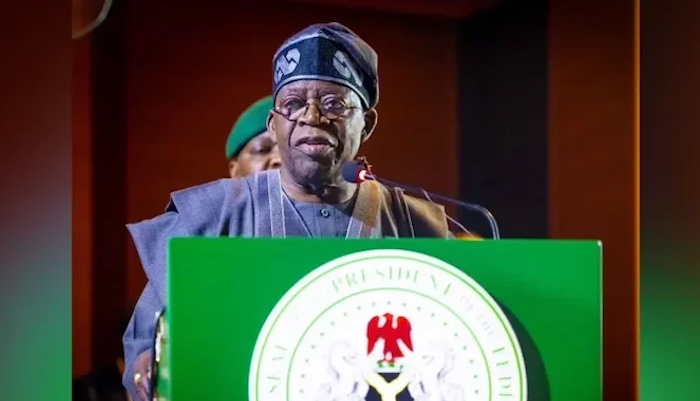
The National Councillors Forum of Nigeria has formally declared its support for President Asiwaju Bola Tinubu’s re-election in 2027, citing the restoration of Local Government autonomy as a landmark achievement for grassroots development.

At a news conference Wednesday in Abuja, the forum described the current administration’s policies as transformational, noting that the “Renewed Hope” agenda is now a living reality in rural communities across the federation.

The forum which also has former councilors as members, emphasized that “as the closest arm of government to the people, councilors understand the aspirations of the citizens and see the direct impact of the President’s strategic reforms”.

Those who spoke on behalf of the forum were President, National Councillors Forum of Nigeria, Dr. Evoh Okechukwu Nwikegwu, the councilor representing Enenaezeraku Ward in Ohaozora Local Government of Ebonyi state; National Coordinator, ST/HT Grassroots Coordinators of Development, Hon. Hyacinth Horvel Turnoe; and National Coordinator, Citizens Network for Peace and Development, Chief Okorie Ikechukwu Rapheal.

The forum which boasts a formidable nationwide network of 8,809 councillors covering all 774 Local Government Areas and 176,836 polling units, said it is one of the largest and most influential grassroots political structures in the country, with a presence felt from urban centres to the most remote villages.

It specifically singled out the restoration of Local Government autonomy as the administration’s crowning achievement, labeling it a game changer for funding and accountability.

According to the group, “this move, combined with improved rural infrastructure and strategic reforms in agriculture, has laid a solid foundation for national prosperity”.

They also commended the President’s efforts in strengthening national security through the modernization of the Armed Forces and enhanced intelligence integration.

The councilors called for nationwide mobilization, urging ward leaders and grassroots coordinators to take the message of the Tinubu administration to every household in Nigeria.

They maintained that the President has demonstrated the necessary courage and competence to deserve a second term to consolidate his work.

National Coordinator, Citizens Network for Peace and Development, Chief Okorie Ikechukwu Rapheal, on his part, asked Nigerians to give the National Assembly a chance to deliver on the amended version of the Electoral Act.


Continue Reading

News

Soludo Visits Onitsha Main Market, Chats With Traders

Published

on

Spread the love

Anambra State governor, Chukwuma Soludo, on Monday, arrived in Onitsha and chatted with traders at the Main Market as shops reopened and commercial activities resumed, marking a significant return to business after years of Monday sit-at-home disruptions in the state.

The reopening of the Onitsha Main Market signalled renewed commercial activities, with traders opening their shops following the state government’s directive to end the sit-at-home and restore everyday economic life.

Soludo’s arrival at the market attracted large crowds of traders, shoppers and journalists.

During his tour of parts of the commercial hub, the governor was seen engaging traders in friendly conversations amid cheers.

At one point, Soludo jokingly bargained over the price of an item and told a trader, “You’re trying to cheat me, I am from the street o,” drawing laughter and excitement from those around.

Monday’s development indicated growing compliance with the state government’s directive to resume business activities, particularly in Onitsha, one of Nigeria’s largest trading centres and a critical driver of the Anambra economy.

Our correspondent  reports that the Monday sit-at-home in Anambra State and other parts of the South-East began in 2021 following directives by the proscribed Indigenous People of Biafra (IPOB), which initially called for residents to stay indoors to protest the detention of its leader, Nnamdi Kanu.

Although IPOB later announced the suspension of the order, however, fear of attacks and sporadic enforcement by non-state actors led many traders to continue observing the sit-at-home.

Last week, despite assurances by the Anambra State Government of improved security, traders at the Onitsha Main Market again stayed away from their shops on Monday, prompting Governor Soludo to order the shutdown of the market and warned that continued defiance would attract stricter sanctions.

Continue Reading

Trending