Connect with us

News

Ohanaeze urges FG to prioritise South East development commission

Published

on

Spread the love


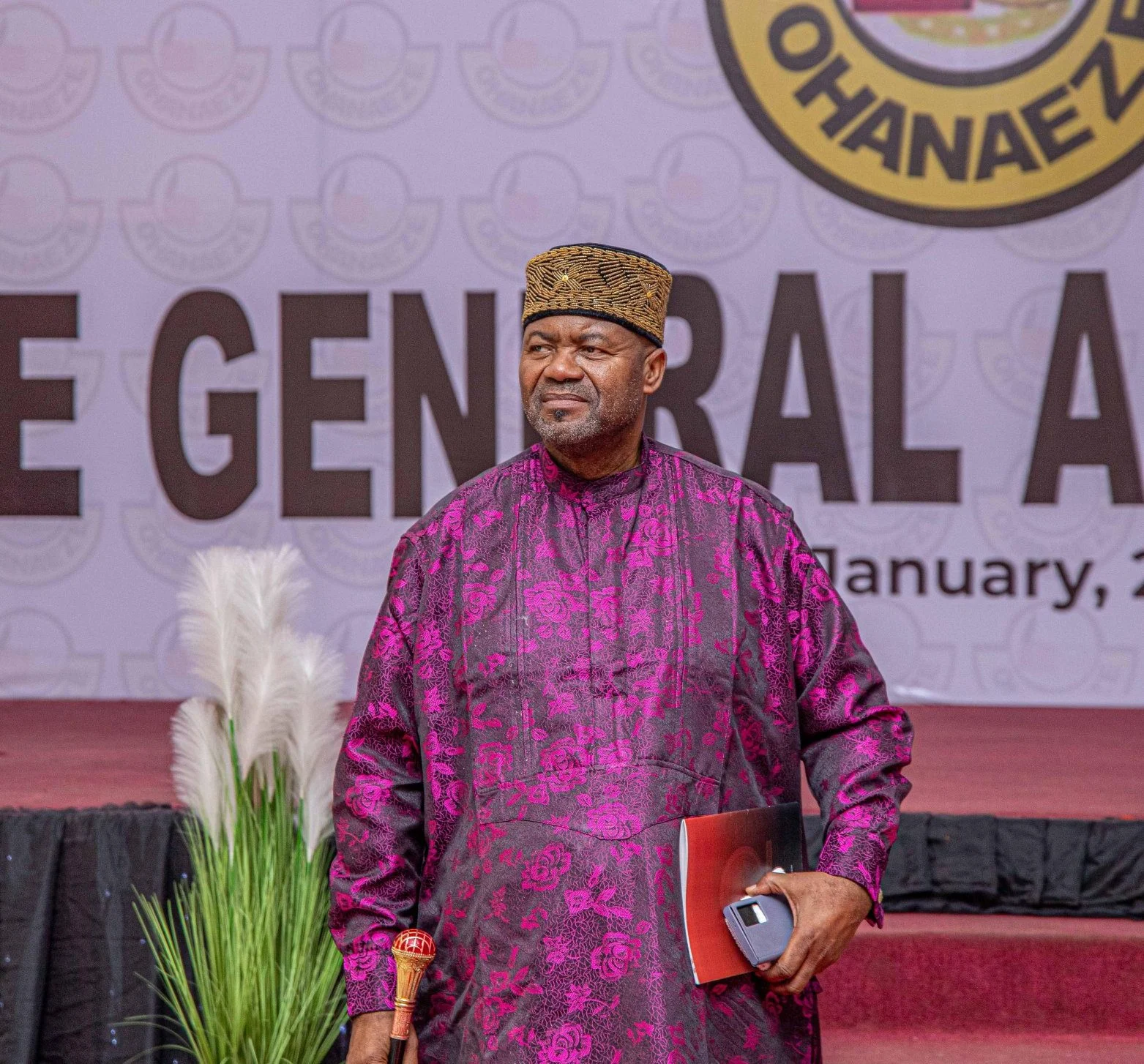
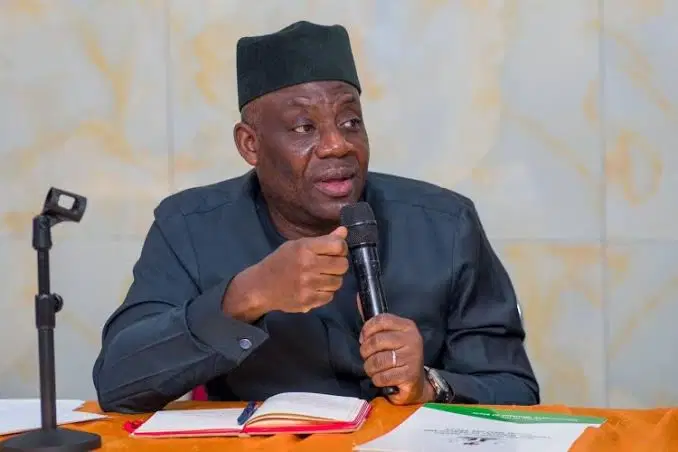
The President-General of Ohanaeze Ndigbo Worldwide, John Azuta-Mbata, has called on the Federal Government to prioritise adequate and sustained funding of the South-East Development Commission as a means of promoting national reconciliation and addressing long-standing grievances in the region.

Azuta-Mbata made the call on Wednesday at the ongoing four-day South-East Vision 2050 Regional Stakeholders Forum in Enugu, describing the commission as a tangible demonstration of the Federal Government’s commitment to equity and justice.

The forum, which began on Tuesday, is aimed at charting a unified socio-economic development roadmap for the South-East and repositioning the region as a global industrial hub by 2050.

It has attracted governors, private sector leaders, professionals in the diaspora and other stakeholders.

While acknowledging the South-East’s significant contributions to Nigeria’s growth through innovation and entrepreneurship, the Ohanaeze leader said feelings of exclusion and neglect had persisted in parts of the region.

“It would be dishonest not to acknowledge that over the years, feelings of exclusion, neglect and unresolved grievances have taken root in parts of our region. If left unaddressed, these sentiments can weaken national cohesion,” Azuta-Mbata said.

He stressed that the importance of the SEDC goes beyond infrastructure development, describing it as a critical instrument for reconciliation and healing.

“I respectfully appeal to the Federal Government to fully utilise the South-East Development Commission by providing it with appropriate and sustained funding.

“This will not only accelerate development, but also help assuage lingering ill feelings, rebuild confidence and heal old wounds in Igboland,” he added.

Earlier, the Managing Director of the SEDC, Dr Mark Okoye, said the South-East is currently burdened by an infrastructure deficit estimated at about $10bn, underscoring the need for regional collaboration.

Okoye urged the five South-East states—Abia, Anambra, Ebonyi, Enugu and Imo—to pursue large-scale, bankable projects collectively rather than compete for limited investment capital.

“The signal sent by the physical and virtual presence of Igbo professional groups from across America, Europe and Asia underscores a collective readiness to rebuild the regional economy,” he said.

He disclosed that the region receives an estimated $4bn annually in diaspora remittances, which, according to him, should be channelled into legacy projects such as regional gas pipelines and other critical infrastructure.

Also speaking, development practitioner Betty Anyanwu-Akeredolu, challenged stakeholders to ensure that the Vision 2050 agenda delivers tangible benefits to rural communities.

“Vision 2050 must move from paper to practice. Development is bigger than party lines; it is about people,” she said, adding that women and youth must be central to the implementation of the vision rather than treated as an afterthought.

Representing Enugu State Governor, Peter Mbah, the Secretary to the State Government, Prof Chidiebere Onyia, welcomed participants and emphasised that no single state could achieve transformational growth in isolation.

He affirmed Enugu State’s commitment to a people-centred, innovation-driven and private sector-led development model.

The forum continues on Thursday with technical sessions focusing on priority sectors such as agriculture, transportation and the digital economy, to produce a comprehensive development roadmap to guide the region over the next 25 years.

Ohanaeze Ndigbo is a pan-Igbo socio-cultural organisation in Nigeria that also operates as a political platform, with members and representatives drawn from various states across the country.

The group is established to articulate, protect and promote the collective interests of the Igbo people, while serving as an umbrella body that brings together Igbo political parties and stakeholders both within Nigeria and in the diaspora.

Click to comment

Leave a Reply

Your email address will not be published. Required fields are marked *

News

Xenophobic attacks: Nigerian lives should not be sacrificed for foreign investors — Oshiomhole

Published

on

Spread the love

The senator representing Edo North, Adams Oshiomhole, has defended his call for the nationalisation of MTN and other South African-owned companies operating in Nigeria, saying the country must prioritise the lives of its citizens over foreign investment.

He made the call on Tuesday during an interview on Arise News, where he reacted to renewed xenophobic attacks against Nigerians in South Africa.

Recall that Oshiomhole, speaking last week on the floor of the Senate, said Nigeria must respond firmly to protect its citizens, stressing reciprocity in international relations.

His words, “I am aware that MTN is quoted, and therefore Nigerian shareholders can hold on, but we take away the South African rights,” he said.

Oshiomhole further proposed that the FG could nationalise affected companies, including financial institutions, and later re-privatise them under Nigerian control.

“And because of the issue… you nationalise, and then you re-privatise it so that Nigerians can take it over, and the profit they are taking out of Nigeria will be retained here. There will be no South African share in it,” he added.

Oshiomhole also claimed that South African authorities only responded meaningfully after diplomatic pressure from Nigeria, though he did not provide evidence for the assertion.

“Thereafter, President Ramaphosa came out clearly to condemn the attack on Black people. He didn’t do that until I attacked his interests,” he said.

He insisted that human life must take priority over economic considerations, arguing that investment should not come at the cost of Nigerian lives.

“If anything leads to the death of Nigeria, what is the value of wealth to the dead? We don’t want investors who invest at the expense of human blood. Even in my poverty, I value my life,” he said.

“Life is more important; we don’t want investors who invest at the expense of human blood. If you need Nigerian blood to service and you don’t care about Nigerian human blood because you want to attract investors, even in my poverty, I value my life.”

The former governor linked his position to what he described as repeated attacks on Nigerians in South Africa, alleging that justice had not been served in previous incidents.

“When a country, for the first time, killed Nigerians, they got away with it. The second time, they killed Nigerians; they got away with it. Third time, they killed Nigerians; they got away with it,” he said.

He added, “Under Buhari, there was an agreement. They broke it. They are killing Nigerians. Nobody is in prison for murder, or extrajudicial murder.

“You are talking about law. Is there no law protecting the life of foreigners who live in your country? Even if they were there illegally, there are legal ways to repatriate them, to deport them,” he said.


Continue Reading

News

UK Exposes Russia’s Network Trafficking Nigerians To Fight In Ukraine

Published

on

Spread the love

The United Kingdom has taken widespread action and imposed sanctions against a shadowy network of traffickers, foreign recruiters and drone suppliers blamed for Moscow’s war in Ukraine and allegedly trafficking vulnerable Nigerians and other nationals to fight in Ukraine.

The UK government on Wednesday said 35 individuals and entities linked to what it described as a “barbaric pipeline” that lures desperate migrants with false promises, only to funnel them into frontline combat or forced labour in Russia’s expanding drone factories have been severely sanctioned.

UK officials noted that recruiters allegedly tied to the Russian have been targeting citizens from countries including Nigeria, Egypt, Iraq and Ivory Coast—offering jobs, education or migration pathways—but ultimately deploying victims to Ukraine under harsh, often deadly conditions.

The notorious Alabuga Start programme, is linked to a sanctioned Russian entity that allegedly channels foreign recruits into drone manufacturing hubs and reports said that in some instances vulnerable Nigerians and nationals of others countries unfortunate to be recruited are sent directly to the battlefield with little or no training and effectively used as “cannon fodder,” according to UK authorities.

“This is exploitation at its most brutal,” UK official Stephen Doughty said, describing the networks as both predatory and integral to sustaining Russia’s war effort. “We are exposing and dismantling the pipelines that traffic vulnerable people and feed illicit components into Putin’s drone factories.”

The sanctions also strike at the technological backbone of Russia’s escalating aerial assaults, a statement from the UK High Commission in Abuja said.

Among those listed is Pavel Nikitin, whose company produces the VT-40—one of the low-cost, mass-produced drones increasingly deployed in attacks across Ukrainian cities. The urgency of the action is underscored by a sharp escalation in drone warfare, the statement added.

In March 2026, Russia reportedly launched more than 200 drones per day—the highest rate since the war with Ukraine began—intensifying strikes on civilian areas and critical infrastructure. Security analysts warn that Moscow’s reliance on cheap, high-volume drone production has reshaped the battlefield and prolonged the conflict.

Nigerian authorities are reportedly disturbed over the alleged role of Polina Alexandrovna Azarnykh, identified as a central figure in coordinating the movement of foreign recruits into Russia before their deployment to Ukraine. British officials also said some of those recruited have already died.

British Deputy High Commissioner in Abuja Gill Lever confirmed that Nigerians have been directly affected, warning that the schemes deliberately prey on economic vulnerability.

“These sanctions shine a light on those exploiting innocent Nigerians to sustain an illegal war,” she said, noting that many victims were misled into believing they were securing legitimate opportunities abroad.

Her comments came about following recent warnings by Nigeria’s Ministry of Foreign Affairs, which had warned Nigerian citizens against suspicious overseas job offers linked to the conflict.


Continue Reading

News

Court orders interim takeover of Sylva’s nine properties

Published

on

Spread the love

The Federal High Court in Abuja has ordered the interim forfeiture of nine properties linked to the former Minister of State for Petroleum Resources, Timipre Sylva, to the Federal Government.

Justice Obiora Egwuatu made the order after the Economic and Financial Crimes Commission counsel, Oluwaleke Atolagbe, moved an ex parte motion to the effect.

Our correspondent reports that though Justice Egwuatu delivered the ruling on April 24, the enrolled order was sighted on Wednesday, May 6.

The affected assets are located across high-value areas in Abuja.

They include four blocks of terraces at Dakibiyu; a duplex with penthouse and office complex at No. 3, Niger Street, MStreet; one standalone duplex at Villa 1, Unit 1, Palm Springs Estate, Mpape; and a block of flats with 10 units of flats at No. 8, Sefadu Street, Wuse Zone 4, Abuja.

Others are blocks of flats with six units of flats at No. 1, Mubi Close, Garki, Abuja; two blocks with 12 units of flats at Plot 1181, Thaba Tseka Crescent, Wuse II, Abuja; one standalone duplex at No. 18, Nile Lake, Plot 1271, Maitama, Abuja,

The ninth property is a two-block building, which is currently occupied by the National Information Technology Development Agency, and is located at No. 5, Aguta Street, Garki, Abuja.

The judge said: “It is hereby ordered as follows: An interim order of this honourable court is made forfeiting the properties listed in the schedule attached herein, being properties suspected to be proceeds of some unlawful activities pending the publication and hearing of the motion on notice for final forfeiture order of the said properties.

“An order of this honourable court is made directing the publication of the interim order under order (1) above for anyone who is interested in the property to appear before this honourable court to show cause within 14 days why the final order of forfeiture should not be made in favour of the Federal Government of Nigeria.”

Justice Egwuatu also granted the EFCC’s request that the publication of the order shall be made in any two of the following newspapers: Thisday, Guardian, PUNCH, Vanguard, Tribune or Independent Newspapers within seven days from the receipt of the certified true copy of the order.

The judge then adjourned the matter until May 25 for a report of compliance.

The commission had, in the suit marked: FHC/ABJ/CS/607/2026, filed the application under provisions of the Advance Fee Fraud and Other Related Offences Act, 2006.

Moving the motion, Atolagbe sought an interim order, forfeiting the properties to the Federal Government pending the publication and hearing of the motion on notice for a final forfeiture order of the said properties.

He said the properties were suspected to be proceeds of some unlawful activities.

The lawyer urged the court to direct the anti-graft agency to make the publication of the order in any national newspaper for anyone who is interested in the properties to show cause within 14 days why the final order of forfeiture should not be made in favour of the Federal Government.

Our correspondent  reports that Sylva, a former governor of Bayelsa State, has also been mentioned in connection with an alleged failed coup plot against President Bola Tinubu, though he has not been formally charged in that case and is reportedly still at large.

Continue Reading

Trending