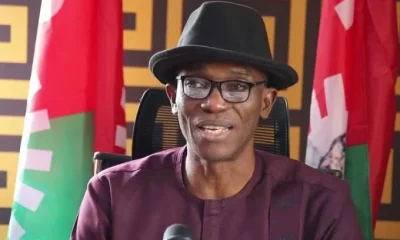
President Bola Tinubu has signed into law the Electoral Act Amendment) 2026, saying in Nigeria, electronic transmission of election results is merely supportive and not a replacement for manual transmission.
This came on a day former Cross River State Resident Electoral Commissioner, REC, Mr. Mike Igini, blamed the Judiciary for recurring challenges in the electoral system.
He also faulted the National Assembly’s decision to retain manual collation as a backup to electronic transmission of election results in the amended Electoral Act.
Signing of the amended Act came days after the Independent National Electoral Commission, INEC, released the time-table for the 2027 general elections.
The signing ceremony took place at the Presidential Villa, Abuja, around 5:00pm, with principal officers of the National Assembly in attendance.
Recall that the National Assembly had on Tuesday, passed the Electoral Act 2026 (Amendment) Bill into law.
The amendment came amid intense public debate over electronic transmission of election results in real-time.
Last week, protests rocked the National Assembly complex as civil society organisations and some opposition figures mounted sustained pressure on the National Assembly to mandate live transmission of results from polling units directly to INEC’s central server.
They argued that it will reduce result manipulation and enhance credibility of the electoral process.
However, the All Progressives Congress and some stakeholders expressed concerns over the technical feasibility of real-time transmission in areas with poor telecommunications infrastructure, making a case for a phased or hybrid approach that allows manual collation where electronic systems fail.
During the 2023 elections, the failure of INEC’s Results Viewing Portal on election day triggered widespread allegations of rigging.
The 2027 general elections are scheduled to hold on February 20 for Presidential and National Assembly elections and March 6 for Governorship & State Houses of Assembly Elections.
Speaking shortly after assenting to the bill, President Tinubu commended the National Assembly for what he described as a rigorous and patriotic process, stressing that the objective of the reforms was to safeguard democratic stability and prevent voter disenfranchisement.
“I followed keenly what you were doing. The essence of democracy is to have very solid brainstorming discussions committed to national development and nation-building and the stability of the nation.
“What is crucial is that you manage the process to the extent that there will be no confusion and no disenfranchisement of Nigerians, and we are all going to see democracy flourish,’’ Tinubu said.
The President emphasised that while technology remains important, elections ultimately depend on human management and public trust.
According to him, the manual voting and counting process remains central to Nigeria’s electoral system, with electronic transmission serving as a support mechanism, rather than a replacement.
He stated: “No matter how good a system is, it is managed by people, promoted by people and finalised by people. You are not going to be talking to a computer; you are going to be talking to human beings who announce the results.
“Essentially, what we are looking at is the transmission of manual results, and we must avoid glitches. Nigeria will flourish and continue to nurture this democracy for prosperity and stability.”
Amended Act will ensure every vote counts — Akpabio
Also speaking after the signing ceremony, Senate President, Godswill Akpabio, declared that the Electoral Act 2026 (Amendment) will ensure that every Nigerian vote counted.
Akpabio said the new piece of legislation eliminated the perennial problem of result manipulation between polling units and collation centres, adding it addressed the core concerns raised by Nigerians over integrity of the electoral process and introduced provisions that will make future elections more transparent and secure.
“At the end, Nigerians will benefit a lot from future elections. Every vote will now count,” the Senate President said.
He noted that the amendment represented the first time since independence in 1960 that Nigeria’s electoral laws will recognise electronic transmission of results.
Akpabio explained that the amended Act mandates the electronic transmission of polling unit results to the INEC Result Viewing Portal, a key demand by civil society organisations, opposition parties, and election observers following widespread allegations of result manipulation during the 2023 general elections.
However, he said the law also took into account areas with poor telecommunications infrastructure, ensuring that the primary source of results remained the EC8A forms signed by presiding officers, party agents, and security personnel at polling units.
“We took cognisance of areas where there may not be any network, where there may not be communication capacities and availability.
“We said, since the polling unit result comes in form EC8A, which is signed by the presiding officer, signed by the agents, and signed in the presence of security agents, copies are given to all.
“Then we can use that as the primary source of collation at that unit. And then, of course, we transmit it. Even if there is no network at that time, once we step out of there, maybe towards the ward centre or the local government centre, it will drop into the iREV and people will still be able to view.”
Akpabio said the implication was that Nigerians will now be able to compare results uploaded to the portal with what was eventually collated at ward, local government, and state levels, making it impossible for results to be tampered with after leaving polling units.
“The implication of that is that if what is eventually collated at the next centre is different from what is in the iREV, Nigerians will be able to compare whether the election result had been tampered with.
“For us, that had always been the problem in the country, that once election results leave a polling unit, they will be tampered with or mutilated. That has been eliminated today,” he said.
The Senate President dismissed suggestions that the National Assembly had bowed to political pressure, insisting that the final provisions of the amendment were the product of thorough consultations and deliberations at plenary of both chambers.
“We are satisfied that we have met the aspiration of Nigerians, not those who are politically motivated,” he said, adding that the Senate had even sacrificed its holiday break to conclude work on the amendment.
He said the amendment also addressed scenarios where election winners were disqualified by courts, noting that instead of declaring the runner-up as the winner, the law now mandated fresh elections to ensure that Nigerians truly elect their leaders.
“We don’t want a situation where, in an election, you have five people contesting, one person out of 300,000 votes, scores 290,000 votes , and then, for one reason or the other, he’s disqualified by the court, and then the person who scored 1,000, who is not popularly elected, will now be declared winner.
“All those things are eliminated. We have now recommended that, where such a case happens, they should call for another election,” he said.
On his part, Speaker of the House of Representatives, Abbas Tajudeen, who also addressed journalists, drew attention to the reduction of the election notice period from 360 days to 300 days.
“This will inadvertently translate to holding the presidential and National Assembly elections in January 2027, and that will technically avoid conducting elections during the month of Ramadan of 2027.
“I think this is another piece of ingenuity that the National Assembly has introduced to avoid voter apathy in the next general election,” the speaker said.
Judiciary must stand tall to save democracy – Igini
Meanwhile, former Cross River State Resident Electoral Commissioner, REC, and lawyer, Mr. Mike Igini, has blamed the Judiciary for recurring challenges in the electoral system, and faulted the National Assembly’s decision to retain manual collation as a backup to electronic transmission of election results in the amended Electoral Bill.
He described the Electoral Act Amendment Bill as a recipe for chaos.
The National Assembly approved electronic transmission of results but retained manual collation as a fallback. The Senate’s decision followed a tense plenary in which 15 lawmakers opposed the controversial Clause 60 of the Electoral Act (Amendment) Bill 2026.
In the House of Representatives, lawmakers reversed their earlier position supporting mandatory real-time electronic transmission to align with the Senate.
Speaking on an interview with Arise Television, yesteday, Igini warned that the amendment could endanger presiding officers and undermine electoral credibility ahead of the 2027 general elections.
Message to Tinubu
He appealed directly to President Tinubu, recalling his history in the pro-democracy struggle.
“You were a senior man in the struggle when democracy was uncertain. What will be presented before you is a recipe for chaos. Be a man of history. What is put before you, please take it back. Don’t sign it.”
History of judicial resistance to electoral reforms
Recalling how the Judicary undemined democracy, Igini traced resistance to electronic reforms to successive electoral cycles.
He recalled that under former INEC chairman, Professor Maurice Iwu, efforts were made to deploy technology for result transmission, but they were sabotaged.
Under Professor Attahiru Jega, biometric voter registration, Permanent Voter Cards, PVCs, and smart card readers were introduced to curb fraud.
However, he noted that in 2015, the Supreme Court ruled that the smart card reader, though innovative, lacked explicit backing in the Electoral Act.
“That debate has held this country down,” he said, blaming judicial interpretations for weakening reforms.
On the IReV portal, Igini criticised the Supreme Court’s position that it is merely a “viewing centre.”
“Regulations and guidelines made pursuant to constitutional powers have the force of law. They are subsidiary legislation,” he argued.
Igini insisted that the judiciary remains central to restoring electoral integrity but lamented what he described as its failure in critical moments.
“Democracy is in danger when the judiciary shows signs of weakness, collapse or irrelevance,” he said.
He argued that electoral disputes should not determine leadership through court pronouncements but reflect the will expressed at polling units.
“Who becomes what must be determined at the polling unit, not in court,” he stressed.
According to him, reforms should prioritise swift adjudication of electoral cases before inauguration and establish long-delayed Electoral Offences Tribunals.
On IReV and Supreme Court
Asked whether results uploaded to the IReV portal would remain justiciable, Igini disagreed with the apex court’s interpretation limiting its legal weight.
“The decision that IReV is merely a viewing centre is contrary to established authorities. Regulations made under constitutional powers have the force of law,” he argued.
He maintained that electronic transmission enhances trust, safety and efficiency.
“Everything we developed was to ensure that who becomes what is determined at the polling unit. The court should not determine governors or legislators,” he said.
Why I broke my silence
On whether lawmakers had heeded his earlier warning that many of them might not return in 2027 without credible electronic transmission, Igini said his intervention was driven by patriotism, not politics.
He lamented that after over a decade of reforms aimed at strengthening electoral integrity, the country appeared to be “back to where we started.”
“For over 30 years of my life, including 10 practical years in INEC, together with other Nigerians, we worked to remove the history of our elections from the poetry of frustration and pain,” he said.
“To now find that all that we did is in vain is painful. But I do not regret serving my country.”
Igini disclosed he turned down consultancy offers after leaving office in 2022 to avoid ethical conflicts.
“It would have been wrong of me to take appointments after being part of the process. On television, I was never paid a dime. It was service to the country,” he said.
Pressed on likely loopholes in the amended electoral law, Igini warned that retaining manual backup could reintroduce the notorious “incident form” abuse.
“The consequence and danger of what has been passed is that we are bringing back another version of the incident form,” he said.
“When a presiding officer says there is no network, even when people can see network on their phones, you are putting that officer’s life in danger.”
He warned that ad hoc staff, mostly youth corps members, would face pressure and possible violence at polling units, while political elites remain insulated.
“The children of political elites will not be at the polling units. It is youth corps members who will face the danger,” he said.
Igini also alleged past collusion involving the duplication of EC8A result sheets with identical serial numbers.
“In 2015 and 2019, there were cases where serial numbers were duplicated. Which one will you pick when two results with identical features are produced?” he queried.
He recounted instances where courts upheld results disputed by INEC, despite the commission distancing itself from such documents.
On turnover in the National Assembly
Responding to suggestions that high turnover in the National Assembly is inconsequential, Igini disagreed. “We have had brilliant legislators who showed integrity but did not return because governors determine who gets tickets,” he said.
He maintained that credible processes protect both voters and lawmakers.
“All you need to do is compare the list of those elected in 2019 with those in 2023. The figures are there,” he said.
Security, collusion and network manipulation
The former REC warned that provisions allowing discretion over network availability could be abused.
“The capacity to connive and ensure there is no network exists. It has happened before,” he alleged.
He cited past elections where communication systems were allegedly jammed during governorship polls.
He also raised concerns about ad hoc staff recruitment, noting that once directives leave INEC headquarters, thousands of temporary staff execute elections at ward and polling unit levels.
“In Akwa Ibom alone, I deployed over 28,000 ad hoc staff. These are the people who conduct elections. If you give them omnibus discretion, it can be abused,” he warned.
Way forward
Despite his criticism, Igini urged Nigerians not to despair, saying ,”the greatest option we have is the judiciary, which must stand tall in defence of democracy and rule of law.”
He called for reforms that shift the burden of proof of credible elections to the electoral management body and ensure disputes are resolved before winners are sworn in.
He also emphasised the roles of security agencies, media and civil society in safeguarding the vote.
“Democracy is not self-executing. Every arm of government and every stakeholder must act responsibly,” he said.
Democracy at a crossroads
Igini noted that Nigeria stands at a critical juncture.
“In the absence of swift and courageous interpretation of the law, democracy will suffer,” he warned.
He insisted that electoral provisions were designed to cure specific mischief and should not be diluted through elite compromise.
“That is the only way we can build a society where there is opportunity for all and responsibility for all,” he said.