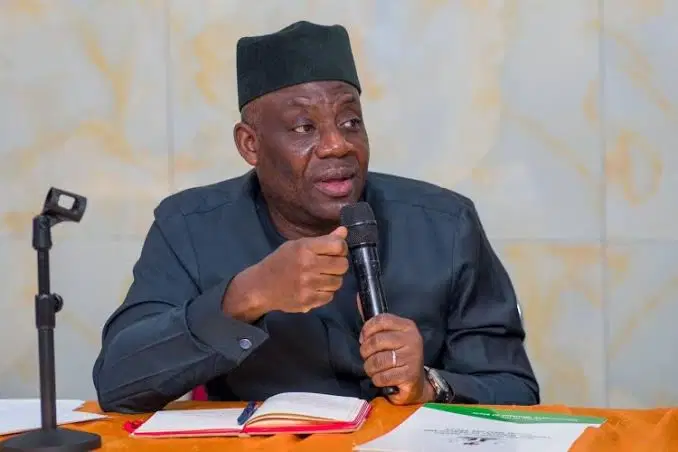

Member representing Ezeagu Federal Constituency, Hon. Sunday Umeha, has flagged off three major road projects in Ezeagu Local Government Area of Enugu State, describing the development as a “treble score” for the constituency.
The projects include the Amankwo Imezi – Ndiagu Oghe Road, the Amansiodo – Ihuonyia – Oghe Road, and the Akama Oghe Road, all aimed at boosting rural connectivity and easing transportation challenges in the communities.
Hon. Umeha expressed appreciation to President Bola Ahmed Tinubu, the Speaker of the House of Representatives, and Minister of Innovation, Science and Technology, Hon. Uche Nnaji, for their cooperation in securing approval for the projects. He assured constituents that funding had already been secured, and construction would commence immediately after the flag-off.
“The flag-off exercise will continue in Udi Local Government Area, where roads in two political wards have already been approved,” Hon. Umeha added.
Speaking at the event, the State Director of the Federal Roads Maintenance Agency (FERMA), Mr. Johnbliss Nwoke, appealed to residents of the benefiting communities to support the contractors and report any concerns regarding the quality of work.
The projects are expected to improve accessibility, stimulate local commerce, and enhance the overall quality of life for residents in Ezeagu and beyond.
The defection of the 2023 Labour Party presidential candidate, Peter Obi, to the African Democratic Congress has begun to boost the party’s political strength in the South, with no fewer than eight federal lawmakers reportedly set to officially join the ADC, barring any last-minute change of plans.
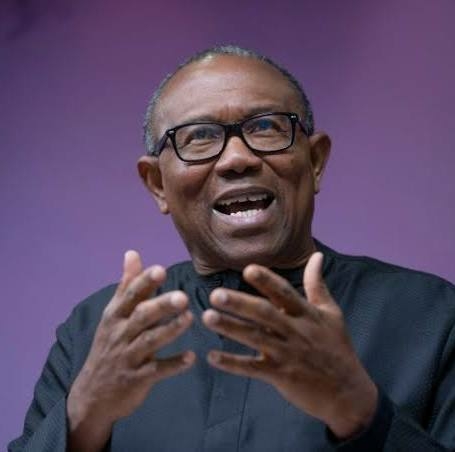
Obi, a former governor of Anambra State, joined the ADC in Enugu on Wednesday, calling on Nigerians and opposition groups to come together under a broad national coalition to “rescue Nigeria from poverty, disunity and democratic decline.”
Explaining his reasons for leaving the LP for the ADC, Obi stated that his decision was driven by patriotism and a desire to rescue Nigeria from the APC.
“This decision is guided solely by patriotism and national interest. I now respectfully call on my political associates, the Obidient Movement and opposition leaders across the country to join this broad national coalition under the African Democratic Congress. History will not forgive silence in moments of national peril,” he said.
In a post shared on his verified X (formerly Twitter) handle on Wednesday night, Obi said three serving senators and several members of the Federal House of Representatives were present at his defection ceremony, signalling their readiness to join the party.
He said, “Notable senators present included Enyinnaya Abaribe, Victor Umeh, Tony Nwoye, and Gilbert Nnaji. Additionally, we had prominent political figures such as High Chief Ben Obi, Chief Onyema Ugochukwu, Prof. Pat Utomi, Prof. Osita Ogbu, Chief Ralph Nwosu, and others, alongside various members of the Federal House of Representatives and State Houses of Assembly, as well as community leaders.”
During the defection ceremony, our correspondent gathered that eight federal lawmakers, including three serving senators mentioned by Obi, were also announced as having collectively defected to the ADC.
The remaining five lawmakers, said to be current House of Representatives members from Anambra State, dumped the Labour Party.
They include Afamefuna Ogene (Ogbaru Federal Constituency), Oby Orogbu (Awka North/Awka South Federal Constituency), and Harris Okonkwo (Idemili North/Idemili South Federal Constituency).
Others are Emeka Godwin (Onitsha North/Onitsha South Federal Constituency) and George Ozodinobi (Dunukofia/Njikoka/Anaocha Federal Constituency).
However, their defections have yet to be formally announced on the floor of both chambers of the National Assembly.
Speaking to our correspondent , ADC National Publicity Secretary, Bolaji Abdullahi, said Obi’s formal defection had boosted the party’s momentum and more federal lawmakers were likely to join ahead of the 2027 presidential election.
“Obi’s defection has given traction to the ADC, and we are expecting more quality politicians like him to join us. Others should make up their minds on time.
“We are expecting more lawmakers and other political bigwigs. Discussions are ongoing with them, and the engagements have been positive so far. We are expecting them in the next few weeks,” Abdullahi said.
Obi had joined other opposition leaders in July to present the ADC as a coalition platform to challenge President Tinubu in the 2027 election.
Under the leadership of former Senate President David Mark as National Chairman and former Osun State governor Rauf Aregbesola as National Secretary, the ADC has been positioning itself as a major opposition party ready to take on the All Progressives Congress in the upcoming poll.
Before Obi officially registered as an ADC member, former Vice President Atiku Abubakar, who joined the party in November, had confirmed on August 25 that he would contest for the presidency in 2027.
Similarly, former Rivers State governor Rotimi Amaechi, who joined the ADC in July, confirmed on August 28 that he would seek the party’s presidential ticket.
With Atiku, Amaechi, and Obi all expressing their intentions to run, the number of aspirants vying for the ADC’s 2027 presidential nomination has grown significantly.
APC govs can’t stop Obi — ‘Obidient’
Speaking with our correspondent , Obidient National Leader Yunusa Tanko emphasised that Obi’s major aim of joining the ADC was to get the party’s presidential ticket, as his defection would continue to attract a wave of Nigerians to the party.
Tanko noted that the former LP presidential candidate remained popular despite recent defections by governors to the ruling APC.
He also dismissed concerns that defections by governors in the South-East could weaken Obi’s electoral strength ahead of 2027, describing the former Anambra State governor as a popular candidate capable of outperforming his 2023 showing.
“As far as I’m concerned, he is a popular candidate. He will definitely be able to attract more than what he had in 2023,” he stated.
He argued that electoral outcomes were driven more by the people than by political officeholders, saying, “People want change, genuine change that can translate into good leadership in this country, and Obi represents that.”
Tanko added that governors could not determine voting patterns on their own, as the votes would come from the people, whom he claimed wanted Obi as their next leader.
Members of the Rivers State House of Assembly said they have returned the N100,000 Christmas bonus given to them by the governor of the state, Sir Siminialayi Fubara.
The Assembly, which described the N100,000 cash gift as unsolicited and unapproved, said the governor has continued to spend Rivers’ money without minding the law.
It would be recalled that the governor had released the sum of N100,000 to be paid to civil servants and some public office holders in the state for the celebration of the festive season.
But, the state lawmakers in a statement on Tuesday night, signed by the Chairman, House Committee on Information, Petitions and Complaints, Hon. Enemi Alabo George, rejected the money.
George said: “Today, the 30th day of December 2025, Honourable members of the 10th Rivers State House of Assembly received bank credit alerts of the sum of one hundred thousand naira (N100,000) each. The said unsolicited and unapproved amount was transferred on the instructions of the Governor of Rivers State, Sir Siminalaye Fubara GSSRS, to the personal accounts of members.
“Upon discovery of these unsolicited and unapproved transfers, Honourable Members of the House took immediate steps to formally return the said funds to the account of the Rivers State Government.”
George noted that, as an institution that gives attention to the law, they would not take part in anything that falls short of the law.
He said that since 2023, Fubara has continued to withdraw from the Consolidated Revenue Accounts of the state without legislative approval despite repeated warnings from the House.
He said: “As an institution established by law and guided strictly by the Constitution of the Federal Republic of Nigeria, the Rivers State House of Assembly maintains that all public expenditures must follow due process, including legislative approval.
“The Governor, since assumption of office in 2023, has consistently drawn from the consolidated revenue accounts of Rivers State without legislative approval, despite repeated warnings from the House, judgment of the Supreme Court and in defiance of the Constitution and principles of separation of powers.
“Therefore, with the leave of Mr Speaker and the entire House, I cease this medium to once again draw the attention of all staff of the Rivers State Government who connive with the Governor and others to contravene the Constitution and laws of Rivers State to the fact that we have become aware of their unlawful conduct.”
The Labour Party and the Action Democratic Party have begun talks aimed at building a broad political alliance to adopt consensus candidates for future elections, starting with the Federal Capital Territory Area Council polls and the Osun State governorship election.
The parties said the proposed arrangement would also involve joint voter education, campaigns and mobilisation for agreed candidates, as part of efforts to strengthen opposition politics and improve governance outcomes.
The initiative, they said, would kick off with the FCT Area Council election scheduled for February 21, 2026, and later extend to the Osun governorship poll slated for August 8, 2026.
The plan is being pursued under a platform tagged Ballot Alliance for Good Governance, following an inaugural consultation between the Labour Party, represented by its acting National Publicity Secretary, Prince Tony Akeni, and the Action Democratic Party, represented by its National Youth Leader, Chinazam Ike.
Briefing our correspondent on the sidelines of the programme in Abuja, Akeni described the proposed arrangement as a departure from conventional party mergers.
“The concept of ‘Voters Ballot Alliance’,” he said, “is the first of its kind in our country’s practice of democracy.
From Independence till date, there is no record like it.
He explained that unlike mergers, which require amendments to party constitutions and registration documents, the ballot alliance model is voluntary.
“While conventional political party mergers entail mandatory amendment of party name, constitution and other registration instruments with the electoral commission, the concept of ‘voters ballot alliance’ is a voluntary agreement among multi-party grassroots faithfuls reached by participating political parties,” Akeni said.
According to him, the alliance allows parties to rally around the most viable candidate without abandoning their identities.
“It is an agreement to adopt the most viable, electorate-accepted candidate among the candidates of various political parties contesting for a particular office in a given election. This is done without the participating parties abandoning their original party platforms or identities,” he added.
Akeni said the model was designed to prevent opposition parties from splitting votes and losing elections.
“The rationale of the concept is that instead of various political parties splitting or fragmenting their votes and losing to an oppressive or unfavourable political party, the various parties in a specific constituency come together and reach a pre-election and post-victory terms of office or power sharing,” he said.
He added that under the arrangement, parties would jointly campaign, protect votes and ensure that results reflected the will of the electorate.
“On election day, the political parties in the ballot alliance vote for, jointly protect the votes and ensure that the actual vote count and winner is announced, paving the way for the victory of the alliance candidate,” he said
Akeni said the alliance, if consistently applied across elections, could reshape Nigeria’s political landscape.
“It is our conviction that if this model is diligently followed from electoral constituency to constituency… the process will produce an assortment of election winners from different political parties in every election across the states and the country at large,” he said.
He added that the outcome would “open the political space for the best of citizens to emerge, irrespective of political party differences, promote good governance, strengthen virile and purposeful opposition politics, restore and strengthen true multi-party democracy in our country.”
Speaking on behalf of the ADP, Chinazam said youths would play a central role in driving the alliance.
“The youths are the strength and vanguard of elections. If Nigeria’s youths, who form the highest blocs of voting populations, key into the outstanding benefits of the Ballot Alliance concept, good governance, which has eluded our country for so long, will be achieved in record time,” he said.
He disclosed that the parties planned to test the model in multiple elections.
“Our plan is to put the Ballot Alliance model to test using the February 21st, 2026, Abuja FCT council elections, Osun state and subsequent Ekiti governorship elections as multi-tier pilot projects,” Chinazam said.
He added that discussions were ongoing to convene a broader conference of political parties early next year.
“This is why our party, the ADP, the Labour Party and others are now in talks for a conference of the Ballot Alliance for Good Governance as early as possible in the new year,” he said.
Chinazam also said the alliance would not exclude major parties.
“The best aspect of the alliance project is that no political party is left out. This includes the major ruling parties, the APC and PDP,” he said.
According to him, performance, not party label, would determine support.
“So, if a ruling party’s candidate in an election is doing well, bringing real developments to his or her constituents… such a candidate, whether he belongs to the APC or PDP, will also be adopted to be returned in the polls,” he said.
He concluded that the ultimate goal was to elect leaders committed to good governance “irrespective of political party affiliations.”