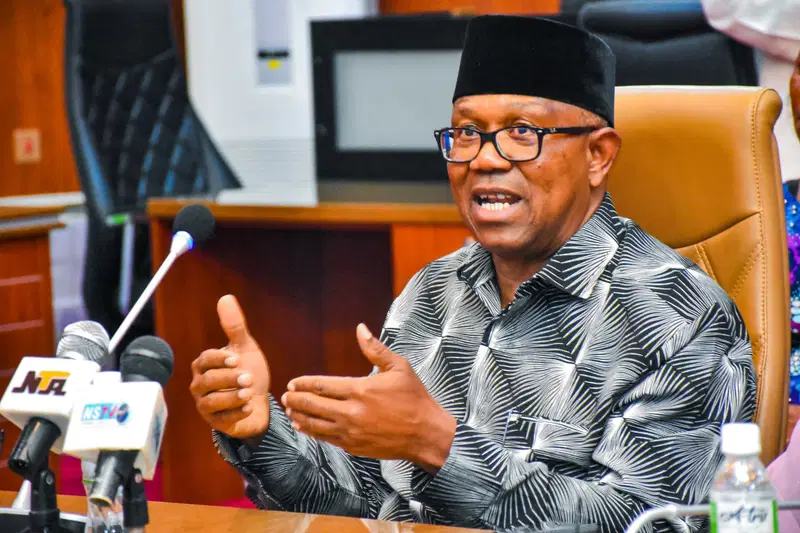
The Labour Party (LP)’s presidential candidate in the 2023 general election, Peter Obi, has again decried what he described as President Bola Tinubu’s administration’s penchant for reckless borrowing without accountability.
Obi spoke in response to the latest external borrowing plan approved by the Senate.
The Nigerian Senate had approved another external borrowing of $21 billion, €2.2 billion, and ¥15 billion for the 2025–2026 fiscal cycle.
The former Anambra State governor noted that with the latest approval, Nigeria’s debt now stands at N187 trillion with palpable fear that it might climb to N200 trillion before the end of the year.
Writing on his X handle on Tuesday, Obi said, “On July 22, 2025, the Nigerian Senate approved an additional $21 billion, €2.2 billion, and ¥15 billion of external borrowing for the 2025–2026 fiscal cycle.
“It also approved a N750.98 billion domestic bond issuance and a €65.65 million grant. With an already existing public debt of about N149.39 trillion as of the first quarter of 2025, adding the approved loans of about N37.2 trillion brings our current total debt to about N187 trillion, with concerns that our debt might likely be over N200 trillion by the end of 2025.
“As our GDP before rebasing was about N269.2 trillion (about $180 billion), the government has borrowed the equivalent of nearly 70% of our previous GDP. Even after the rebasing, which pushed our GDP to about N372.8 trillion (about $243.7 billion), the government would have borrowed about 50.16% of the new GDP (with the approved loans), the highest debt-to-GDP ratio in our history as a nation.
“While the year-on-year increase is about N27.72 trillion and the quarter-on-quarter increase is about N4.72 trillion, we are accumulating very exponential levels of unsustainable debt with little or nothing to show for it in critical areas such as education, healthcare, electricity generation, security of lives and property, and pulling people out of poverty.
“We still rank low in all major human development indicators. While education is underfunded and the standard is in continuous decline, healthcare remains inaccessible to millions of Nigerians, particularly the poor.
“Security of lives and property has deteriorated, with over 10,217 people killed and 672 villages sacked between May 29th, 2023, and May 29th, 2025, even when security spending has significantly increased from N2.98 trillion in 2023 to N4.91 trillion in 2025.
“Infrastructure decay persists across the country, with about 135,000 km of our 195,000 km of roads remaining unpaved, largely unmotorable, and unusable.
“It is the same depressing situation in almost all sectors of the economy, with the power sector an unquestionable example, with less than 5,000 MW supplied for over 200 million Nigerians.
“Today, over two years after the present government took over and with all the humongous borrowing, we are still confronted with negative reports of worsening poverty with about 133 million (63%) Nigerians classified as multi-dimensionally poor, increasing unemployment, and disheartening news like 652 children dead as the malnutrition crisis worsens in Northern Nigeria.
“Médecins Sans Frontières (MSF), also known as Doctors Without Borders, has just sounded the alarm over an escalating malnutrition crisis in Northern Nigeria, with Katsina State emerging as one of the worst-hit areas
“This is a country blessed with enormous resources, yet nobody should go to bed hungry. Still, a persistent deficiency in leadership has thrown the majority of our citizens into increasing multi-dimensional poverty.
“Borrowing is not inherently bad if it is sustainable and tied to productive investments with measurable outcomes. Unfortunately, this current pattern of borrowing without accountability, without transparency, and without transformational impact is simply mortgaging the future of our children.
“The government should consider the intergenerational consequences of their unsustainable borrowings and show at least a minimum consideration and interest in the future of young and unborn Nigerians.
“We must return to a disciplined and prudent economic management culture, cutting the cost of governance, blocking leakages, investing in human capital, and building a productive economy. Nigeria cannot continue to borrow recklessly while poverty deepens and public trust erodes.
“It is time to stop this fiscal indiscipline. We must build a New Nigeria, where leadership is responsible, development is people-centred, and every kobo borrowed or spent delivers a measurable impact to achieve sustainable and inclusive development and growth.”
A United States federal court has sentenced a Nigerian national, Tochukwu Albert Nnebocha, to more than eight years in prison for his role in a transnational inheritance fraud scheme that targeted elderly and vulnerable Americans.
According to a statement published on the US Department of Justice (DOJ) website on Friday, “a Nigerian National was sentenced today to more than eight years in prison for participating in a years-long conspiracy to defraud elderly and vulnerable Americans through an inheritance fraud scheme.”
The DOJ said Nnebocha, 44, and his accomplices ran the operation for over seven years, describing it as a sophisticated international fraud network that preyed on victims across the United States.
The statement read, “According to court documents, Tochukwu Albert Nnebocha, 44, of Nigeria, and his co-conspirators operated a lucrative transnational inheritance fraud scheme that exploited vulnerable people in the United States.
“Over the course of more than seven years, Nnebocha and his co-conspirators sent hundreds of thousands of personalized letters to elderly individuals in the United States, falsely claiming that the sender was a representative of a bank in Spain and that the recipient was entitled to receive a multimillion-dollar inheritance left by a deceased family member.”
Victims were later instructed to make multiple payments before they could access the supposed inheritance.
“The conspirators then told the victims that, before they could receive their purported inheritance, they were required to send money for purported delivery fees, taxes, and payments regarding the inheritance. In total, the defendant and his co-conspirators defrauded over 400 U.S. victims of more than $6 million,” the statement read.
The DOJ added that “in total, the defendant and his co-conspirators defrauded over 400 U.S. victims of more than $6 million.”
Authorities disclosed that Nnebocha was arrested in Poland in April 2025 and extradited to the United States in September 2025. He subsequently pleaded guilty in November 2025 to conspiracy to commit mail fraud and wire fraud.
At sentencing, the court imposed a 97-month prison term, followed by three years of supervised release, and ordered restitution of more than $6.8 million to the victims.
The department noted that “this is the second indicted case related to this international fraud scheme,” adding that eight co-conspirators from the United Kingdom, Spain, Portugal and Nigeria had already been convicted and sentenced.
Investigations were conducted by the US Postal Inspection Service and Homeland Security Investigations, with support from the Federal Bureau of Investigation’s Legal Attaché in Poland, INTERPOL, Polish authorities, the US Attorney’s Office for the Southern District of Florida, and the DOJ’s Office of International Affairs.
Senior Trial Attorney Phil Toomajian and Trial Attorney Joshua D. Rothman of the Criminal Division’s Fraud Section are prosecuting the case, the statement said.
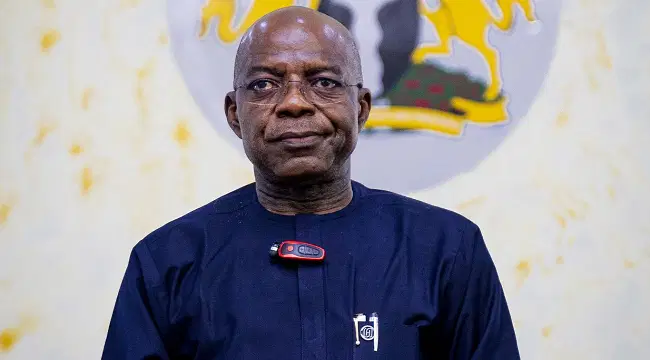
The Anambra State Police Command has arrested a housewife, Mrs. Edeh Osinachi, for allegedly using a hot iron to punish her 17-year-old house help for making a phone call without permission.
The victim, a student, was brought to the police station by an official from the Ministry of Education, who reported the incident. School authorities had noticed severe injuries on the girl’s body during a teaching session, prompting further investigation.
The victim revealed that Mrs. Osinachi, angered by her use of the phone, inflicted the injuries using a hot pressing iron as punishment.
Anambra State Police Public Relations Officer, SP Tochukwu Ikenga, confirmed that during interrogation, the suspect admitted to the act.
“The suspect allegedly abused and inflicted serious injuries on a 17-year-old girl said to be her house help in Awka. The Anambra State Police Command, while commending the vigilance of the school authorities, assures the public that a thorough investigation will be conducted and justice served in accordance with the law,” Ikenga stated.
He further advised parents to have only as many children as they can adequately care for to prevent children from becoming vulnerable while under the care of others.
The PPRO added that the arrest reflects the command’s continued commitment to the welfare and safety of students and pupils across the state
The Federal Government has reaffirmed its determination to end what it described as long-standing interference by state governments in funds constitutionally allocated to Nigeria’s 774 local government areas, warning that the era of unchecked control over grassroots finances is coming to an end.
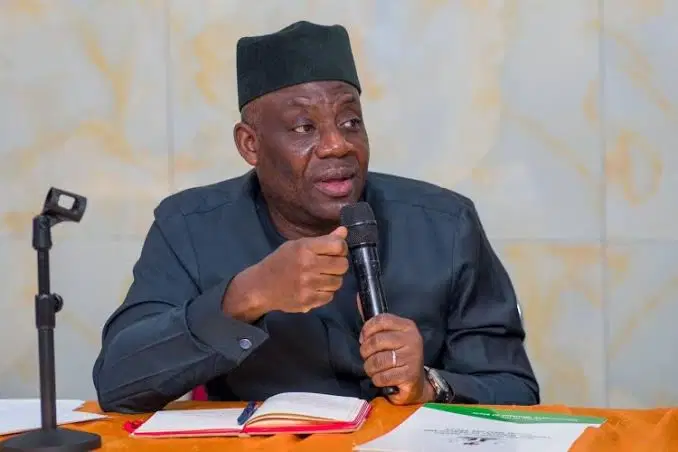
Mr. Mohammed Shehu, Chairman of the Revenue Mobilisation Allocation and Fiscal Commission (RMAFC), made the declaration on Thursday in Abuja during the 2025 budget performance review and 2026 budget defence before the House of Representatives Committee on Finance, chaired by Hon. Abiodun James Faleke.
Shehu expressed concern over the persistent erosion of local government autonomy, blaming state interference for the poor functionality of councils nationwide. He announced that the Commission would re-establish a dedicated Local Government Monitoring Committee to track revenues and operations across all councils.
“The Commission will now monitor every single local government in Nigeria,” Shehu declared. “The crisis we are facing today is largely due to the non-functionality of local governments. Even under military rule, councils performed better than what we see today.”
He disclosed that President Bola Ahmed Tinubu has personally engaged state governors on the matter and is prepared to issue an Executive Order if necessary to enforce compliance. Shehu affirmed that RMAFC is fully aligned with the President’s position to protect local government funds and restore grassroots governance.
Shehu also credited the House Committee on Finance for strengthening the Commission’s institutional standing, noting that RMAFC now commands greater respect among revenue-generating agencies. “Today, agencies like the Nigerian Customs Service, NUPRC and others engage us proactively. Long-standing issues are being resolved because the Commission has been empowered to do its job,” he said.
Highlighting recent achievements, the RMAFC chairman revealed that the Commission conducted an unprecedented audit and physical verification of oil assets across the Niger Delta, describing the exercise as historic and far-reaching.
“For the first time, oil wells across the Niger Delta are being verified physically. Our teams spent three to four months in the field, going deep into creeks to identify Nigeria’s oil assets,” Shehu said. “When Mr. President receives this report, the country will shake.”
He emphasized that the exercise was carried out independently without relying on state governments for logistics, marking a major shift from past practices.
Shehu further informed lawmakers that the review of the revenue allocation formula among the three tiers of government is nearing completion, alongside a review of remuneration for political office holders. “Analysis of the data is almost concluded. The remuneration of political office holders has been completed and submitted to Mr. President through the Secretary to the Government of the Federation,” he said, adding that the revised revenue sharing formula would be finalized within the year.
In his response, Chairman of the House Committee on Finance, Hon. Abiodun James Faleke, commended the RMAFC management for its renewed drive and improved revenue oversight, describing the Commission’s performance as critical to Nigeria’s fiscal stability.
The session ended with lawmakers urging the Commission to sustain its momentum in strengthening transparency, accountability, and equity in the nation’s revenue management system.