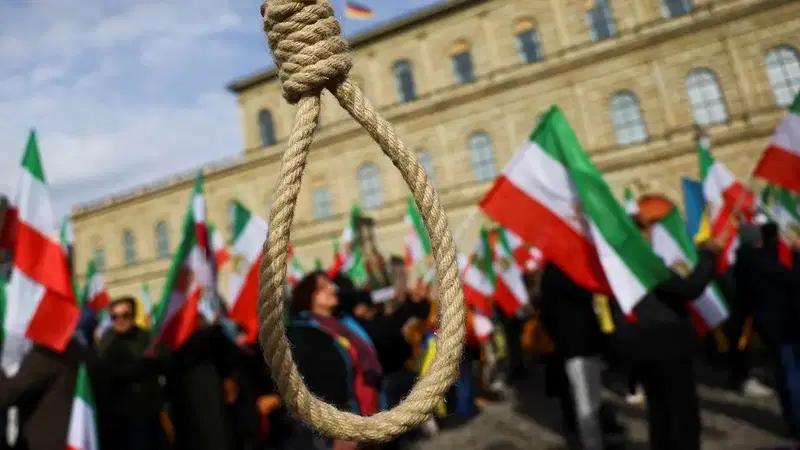
Iran’s Supreme Leader Ayatollah Ali Khamenei says Israel initiated a war
Iran launched a fresh barrage of retaliation strikes on Tel Aviv and Jerusalem, killing one woman, injuring dozens and sending terrified civilians into shelters.
Israel said the military’s defense systems have been intercepting the missiles throughout the day Friday, and that most were intercepted or fell short. Air raid sirens could once again be heard across Israel as the sun began to rise on Saturday.
The strikes were in retaliation to Israel’s blistering attacks on the heart of Iran’s nuclear and military structure overnight Friday, a barrage it said was necessary before Iran got any closer to building an atomic weapon.
At least 78 people were killed and more than 300 wounded in the strikes on Iran, the country’s ambassador told the U.N. Security Council. He said “the overwhelming majority” of victims were civilians.
Iran’s Supreme Leader Ayatollah Ali Khamenei said Israel initiated a war and it would not be allowed to do “hit and run” attacks without grave consequences. He vowed not to let Israel “escape safely from this great crime.”
Aerial bombardment rocks Tel Aviv as Israel-Iran conflict escalates
Fears of all-out war in Middle East rise after Israel strike Iran’s nuclear sites
Israel has long threatened to carry out military action against Iran’s nuclear facilities, claiming Tehran was secretly building an atomic bomb.
The strikes were carried out Friday, raising the prospect of a regional war between the longtime foes over Tehran’s nuclear program.
Israeli Prime Minister Benjamin Netanyahu said his country had started a “targeted military operation to roll back the Iranian threat to Israel’s very survival.”
“This operation will take as long as is needed to complete the task of fending off the threat of annihilation against us,” he added.
Peter Obi has expressed strong concern over the political situation in Guinea-Bissau, citing comments made by former President Goodluck Jonathan, who served as an election observer in the country.
“I listened closely to Dr. Goodluck Jonathan’s briefing. As a former President who was on ground as an election monitor, he noted that the so-called coup appeared suspicious,” Obi said. He added that Jonathan had described the incident as unusual, pointing out that “it was the president himself who announced the coup and relayed the details to the international community.”
‘ECOWAS was quick on Guinea-Bissau, silent elsewhere’
Obi noted that reports from Guinea-Bissau indicated the election process was peaceful, with only the formal announcement of results pending before events took a strange turn.
“ECOWAS was swift to sanction Guinea-Bissau, but what does ECOWAS do when democracy is subverted — not by soldiers, but by technology?” he asked.
‘Do we condemn only coups with guns?’
The former Anambra governor questioned whether the regional bloc would apply the same standards to countries where election outcomes are disrupted by conveniently timed ‘glitches.’
“Do we only condemn coups that are visible with guns and ignore those executed through deliberate technological failure?” he queried.
Obi warned that both technological manipulation and political interference pose serious threats to electoral integrity. “Whether technical or political, these issues can undermine democracy, stall progress, and deny African citizens their right to freely choose their leaders,” he said.
A call for transparency across West Africa
Obi stressed that democracy can only thrive when transparency, accountability, and the will of the people are upheld.
“By confronting these challenges honestly, we can move towards a New Nigeria and a more stable, democratic West Africa. Our goal must be to ensure that the people’s will prevails and our elections reflect the true desires of our citizens.”
He added that the Guinea-Bissau incident mirrors a broader regional crisis.
“The episodes in Guinea-Bissau highlight two faces of the same problem: one where ballots are overturned by force, and another where ballots are obstructed by convenient technical excuses,” he said.
“In both situations, the citizens lose, democracy is weakened, and the region sinks deeper into instability. The result is the same — the people are denied their mandate.”
U.S. President Donald Trump has issued a strong warning to Nigeria’s government over the rising wave of killings and kidnappings across the country. Speaking during a Fox News discussion, Trump condemned the ongoing violence and accused Nigerian authorities of failing to act decisively despite receiving huge support from the United States.
Trump described the situation as “a disgrace,” saying terrorists continue to target villages, schools and churches while citizens live in fear. He expressed anger that the crisis has been ignored for too long, especially the attacks on Christian communities.
According to the broadcast, gunmen recently stormed a Catholic secondary school in Northwestern Nigeria, kidnapping an estimated 52 students in a single night. Days earlier, another Catholic church in the same region was attacked, leaving two people dead and 38 worshippers abducted.
A U.S. foreign policy expert on the panel noted that over 22 terrorist groups, including Boko Haram and factions linked to ISIS, are currently active in Nigeria. He described the attacks on schoolchildren as “horrific,” highlighting that many of the victims are young girls who end up trafficked or forced into slavery.
The discussion also addressed the growing concern that Nigeria’s security agencies are struggling to contain the violence. Analysts argue that the government’s response has not matched the seriousness of the threat, allowing insurgent groups to expand their operations.
Despite Nigeria’s denial of religious persecution, critics maintain that rural communities remain unprotected as kidnappings and mass killings increase each week. The situation has now drawn international attention, with many calling for stronger action from global partners.
Trump’s warning adds pressure on Nigeria to demonstrate real commitment to securing its citizens. Whether his comments will lead to policy changes or international intervention remains unclear, but the message has already sparked debate within diplomatic circles.
Israel’s defence minister vowed Thursday to inflict the biblical 10 plagues of Egypt on Yemen’s Huthi rebels after they stepped up their missile attacks against Israel.
“The Huthis are firing missiles at Israel again. A plague of darkness, a plague of the firstborn — we will complete all 10 plagues,” Israel Katz posted on X.
He was referring to the 10 disasters that the Book of Exodus says were inflicted on Egypt by the Hebrew God to convince pharaoh to free the enslaved Israelites.
Earlier on Thursday, the Israeli army said a missile fired from Yemen struck outside Israeli territory, a day after it intercepted two Huthi missiles.
The Huthis’ military spokesman Yahya Saree said the rebels had targeted Tel Aviv’s Ben Gurion Airport with a ballistic missile.
The Iran-backed Huthis have vowed to step up their attacks on Israel, after their prime minister and 11 other senior officials were killed in Israeli air strikes last week.
The Huthis have launched repeated drone and missile attacks against Israel since the Gaza war erupted in October 2023, saying the launches are in support of the Palestinians.
Israel has carried out several rounds of retaliatory strikes in Yemen, targeting ports, power stations and the international airport in Sanaa, the rebel-held capital.