Connect with us

World

Trump opposed Israeli plan to kill Iranian supreme leader – US official

Published

on

Spread the love

US President Donald Trump vetoed an Israeli plan to assassinate Iranian supreme leader Ayatollah Ali Khamenei, a senior US official told AFP Sunday.

“We found out that the Israelis had plans to hit Iran’s supreme leader. President Trump was against it and we told the Israelis not to,” said the US official, speaking on condition of anonymity.

Earlier Sunday, Israeli Prime Minister Benjamin Netanyahu dodged a question about reports that Trump had asked his country not to kill Khamenei.

“I’m not going to get into that,” he told Fox News.

“But I can tell you,… we’ll do what we need to do, and I think the United States knows what is good for the United States,” he said.

The comments came as Israel and Iran exchanged another barrage of missiles Sunday, with residents told to seek shelter as booms were heard over Jerusalem, and aerial defense systems reportedly activated in Tehran.

After decades of enmity and a prolonged shadow war fought through proxies and covert operations, the latest conflict marked the first time the countries have traded fire with such intensity, triggering fears of a lengthy conflict that could engulf the entire Middle East.

It began Friday, when Israel launched an attack that has killed top military commanders and nuclear scientists, and struck military bases, nuclear sites and residential areas across the country.

As Israel struck targets across Iran again on Sunday, Netanyahu vowed to make the country pay a “heavy price” for killing Israeli civilians.

He also strongly suggested to Fox News that Israel had killed Iran’s intelligence chief Mohammad Kazemi, saying it had recently “got the chief intelligence officer and his deputy in Tehran” as its jets carried out raids over the capital.

Trump has insisted that Washington, a strong ally of Israel, “had nothing to do” with Israel’s bombing campaign.

But he also threatened to unleash “the full strength and might” of the US military if Iran attacked US interests, later urging the two foes to “make a deal.”

Trump stressed to ABC News Sunday that the United States is “not at this moment” involved in the military action, but said it was “possible we could get involved.”

He also said he would be “open” to his Russian counterpart Vladimir Putin being a mediator to resolve the conflict.

Click to comment

Leave a Reply

Your email address will not be published. Required fields are marked *

World

Iran executes two men convicted of spying for Israel

Published

on

Spread the love

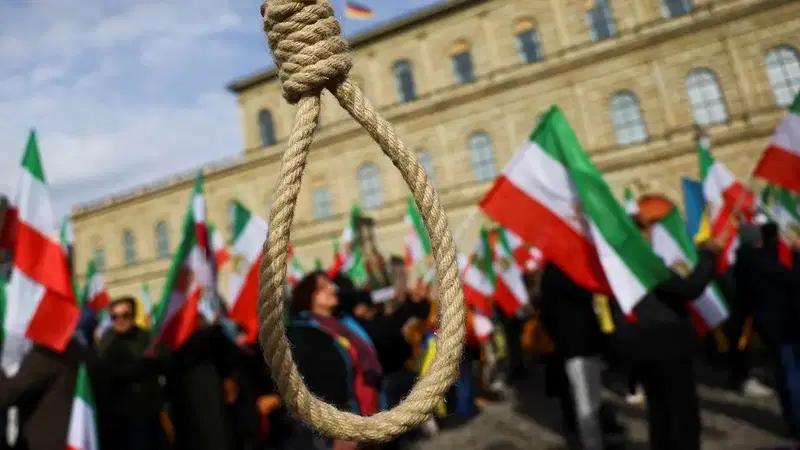
Iran on Monday executed two men convicted of spying for Israel, the judiciary said, the latest in a wave of hangings over alleged espionage.

Since the start of the war with Israel and the United States in February, Tehran has ramped up executions, with many of the convicts accused of spying for Israeli intelligence.

“Omid Behzad and Pouria Safvat were hanged this morning for transmitting the coordinates of sensitive military and security sites to Mossad agents,” said Mizan, the media outlet for Iran’s judiciary, referring to Israel’s foreign intelligence service.

It did not specify when the pair were arrested or when they went on trial, but said they were convicted of “espionage and collaboration with the Zionist regime”.

“They helped the intelligence services achieve their objectives by providing them with information on military and security centres during the war,” Mizan added.

The number of executions in Iran has risen since the start of the war, which broke out on February 28 with massive US-Israeli strikes that killed Iran’s supreme leader.

Iran is the world’s second-most prolific executioner after China, according to rights groups including Amnesty International.

The authorities executed at least 1,639 people last year, a record high since 1989, according to Iran Human Rights, an NGO based in Norway, and Together Against the Death Penalty (ECPM), which is headquartered in Paris.

On Tuesday, Amnesty denounced what it said was the “escalation” in executions after Iran announced the hanging of two men found guilty of taking part in anti-government protests during the winter.

Continue Reading

World

South Africa police move foreigners seeking safety from anti-migrant threats

Published

on

Spread the love

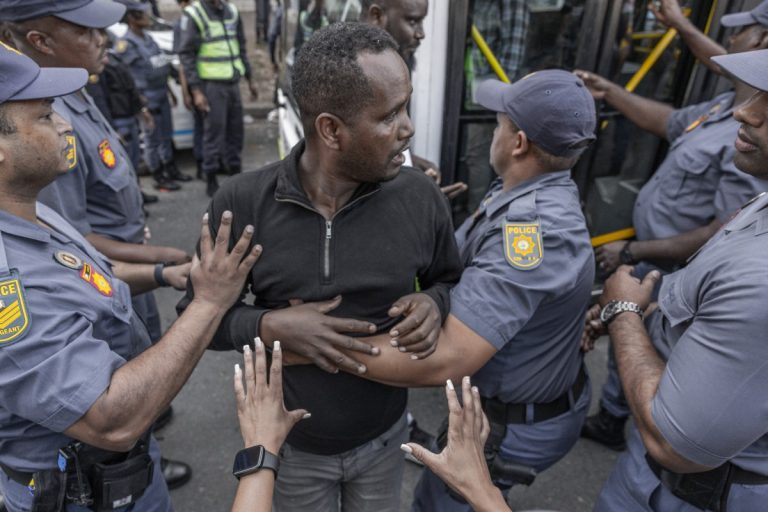
Authorities removed Thursday scores of foreign nationals who had sought protection from anti-migrant groups at a church centre in Durban in a days-long standoff, highlighting xenophobic tensions in South Africa.

Campaigns by small citizen-led groups against undocumented migrants have picked up in recent months, but without reaching the level of violence seen in waves of anti-foreigner attacks over previous years.

Police herded about 400 migrants from countries including the Democratic Republic of Congo, Ethiopia, Rwanda and Somalia onto buses and removed them from the complex in the east coast city where some had been camped for days.

Local anti-immigrant campaigners cheered and chanted “They must go!” as the foreign nationals — including women and children — were driven to a government refugee centre.

Some pressed identity documents to bus windows to show they had the proper papers to be in South Africa.

Several told AFP they had left their homes in fear after anti-immigrant locals went door-to-door to tell undocumented foreigners to leave by June 30.

Their ultimatum has no legal weight and is not backed by the authorities.


There were some scuffles during the evacuation, with one man breaking free and chased by locals before police intervened.

– Blame –

Anti-immigrant figurehead Jacinta Ngobese-Zuma told reporters that her group, March and March, opposed violence but wanted all undocumented foreign nationals to leave.

The group blames migrants for social ills such as high unemployment and crime, but analysts say this is scapegoating.

Meanwhile, Ghana said Thursday it planned to evacuate more than 800 of its citizens from South Africa after a viral video showing the alleged assault of a Ghanaian man triggered outrage.

South Africa has faced recurring waves of xenophobic violence since 2008, when dozens of migrants were killed and thousands displaced.

There were similar flare-ups in 2015 and 2021, often sparked by economic frustrations and political mobilisation around anti-immigrant rhetoric.

The latest spike comes as political parties seek support ahead of local government elections in six months.

One of the migrants at the Durban centre, Robert Ikobia, told AFP he had left the DRC when he was 12 years old to escape war.

“I have the papers to be here. But every time there has been a xenophobic upheaval, I have been a victim,” he said.

“In 2012, I was shot in the head and nearly died. A few years later, I was stabbed by a mob. I fled a war in my country, yet I cannot find peace in South Africa,” he said.


Continue Reading

World

Uganda’s 81-year-old president sworn in for seventh term

Published

on

Spread the love

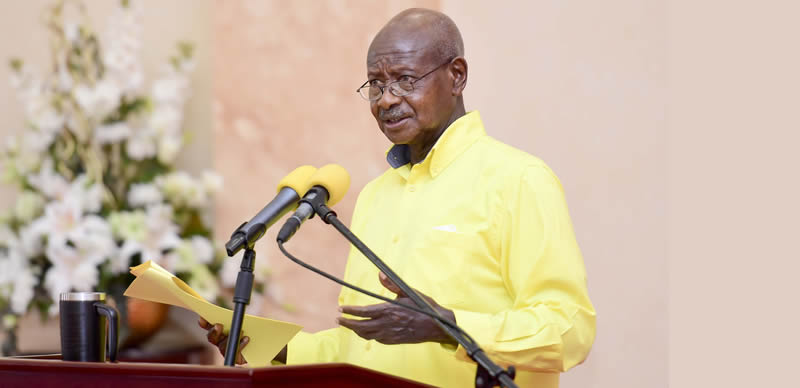
Yoweri Museveni has been sworn in for a seventh consecutive term as president of Uganda, extending his nearly four-decade rule after securing victory in the country’s disputed January elections.

The 81-year-old leader, who first took power as a rebel commander in 1986, was inaugurated at the Kololo Independence Grounds in the capital, Kampala, amid tight security and heavy deployment of armoured vehicles across the city on Tuesday, BBC reports.

According to election authorities, Museveni won more than 70 per cent of the votes cast, with his new tenure expected to run until 2031.

His main challenger, Bobi Wine, rejected the outcome, alleging widespread irregularities and ballot manipulation during the polls.

Wine, whose real name is Robert Kyagulanyi Ssentamu, described the election results as “fake” and accused the government of undermining democracy.

The 44-year-old opposition figure later fled the country, claiming he feared for his life.

“The regime wanted to eliminate me,” he reportedly said after leaving Uganda.

Election officials, however, dismissed allegations of fraud and maintained that the polls were free and fair.

Museveni, now among Africa’s longest-serving leaders, joins figures such as Denis Sassou Nguesso, Teodoro Obiang Nguema Mbasogo, and Paul Biya in remaining in power for more than four decades.

Several African leaders attended the inauguration ceremony, including Samia Suluhu Hassan, Félix Tshisekedi, Salva Kiir Mayardit, and Hassan Sheikh Mohamud.

Uganda has one of the youngest populations globally, with many citizens having known no other president besides Museveni.

Although the Ugandan leader has not publicly indicated when he plans to retire, political analysts have speculated that the current tenure could be his final term in office.

Attention has increasingly shifted toward his son, Muhoozi Kainerugaba, who has been widely viewed as a possible successor.

The military chief has, however, faced criticism over controversial social media posts targeting opposition figures, including Wine.

Meanwhile, rights groups have continued to raise concerns about Uganda’s human rights record and the treatment of opposition politicians following the elections.

Amnesty International recently alleged that at least 16 people were killed by security forces between January 15 and 18 during post-election unrest.

The organisation claimed the victims were unarmed and posed no immediate threat.

Another opposition politician, Kizza Besigye, remains in detention after being arrested in late 2024.

Besigye was charged in a military court over allegations relating to illegal weapons possession and attempts to procure arms abroad, accusations he has denied.

The Ugandan government has also faced criticism over a recently passed Sovereignty Bill, which criminalises activities considered to promote “the interests of a foreigner against those of Uganda” and labels recipients of foreign funding as “agents of foreigners.”

Continue Reading

Trending